

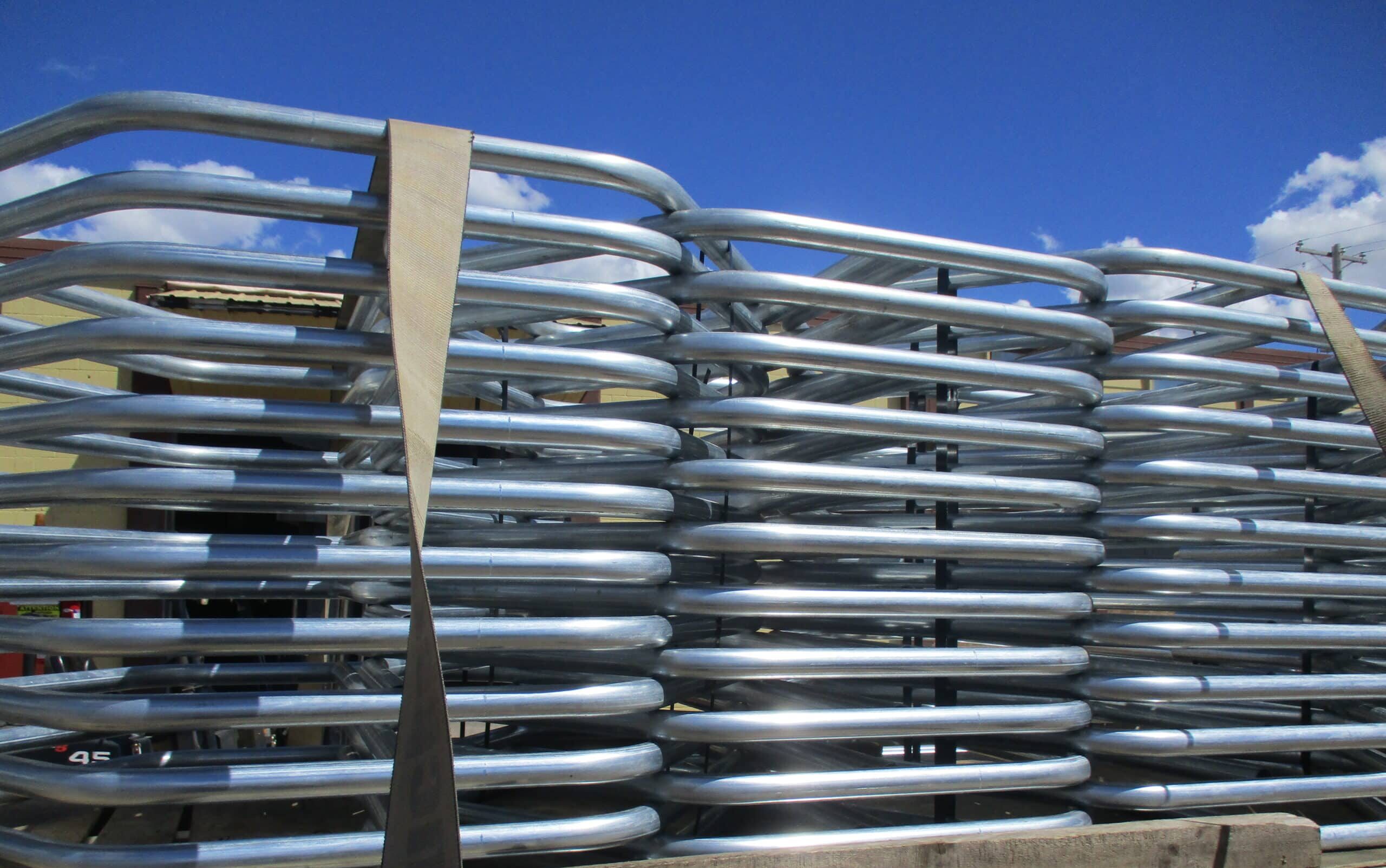
Canada’s industrial fabrication sector is broad, but tube and pipe bending capacity across the country is unevenly distributed. While fabricators in major centres have access to general forming equipment, dedicated bending capability for non-standard, spec-driven, or high-documentation work is concentrated in relatively few shops.
For fabricators running a job with bends outside their own capability or shops whose benders are booked and whose deadlines aren’t moving, knowing where to source that capacity and how to evaluate it is a production problem with a fixed deadline attached.
What Capacity Looks Like in Tube and Pipe Bending
Equipment range, available tooling, and a shop’s ability to hold tolerance on a specific job defines what a bending shop can and can’t take on.
CNC rotary draw bending is the dominant method for precision tube and pipe work. A CNC bender programmed for a specific job produces consistent, repeatable bends across a run, with tight control over angle, radius, and springback compensation. Atlas Industries’ CNC rotary mandrel draw bender covers sizes from ¼” to 4″, including mandrel bends for thin-wall tube and tight inner-diameter work.
The tooling side of the equation is where available capacity gets complicated. Rotary draw bending requires a die set matched to the tubes outside diameter and the specific bend radius. A production bending shop stocks dies for the sizes and radii it runs regularly. Jobs falling outside that set require either purchasing or building tooling. For a one-off or short run, that calculation doesn’t come out in favour of taking the work.
Heavy wall material, tight inner diameters, large-radius sweeps outside standard rotary draw tooling, and thin-wall tube requiring mandrel or wiper-die support are points where a shop’s nominal size range and its ability to hold a given job come apart.
Where Canadian Fabricators Run Into Limits
Fabricators are pushed to source bending capacity outside their own shop when overflow or specialty work comes up.
When the schedule doesn’t align, overflow arises. A bender that is booked, a production run that lands alongside a larger job, or a deadline that won’t accommodate a queue push work outside of capacity. The fabricator can run the job. The shop just can’t run it now.
Specialty work typically calls for a bend the shop isn’t tooled for, or a combination of wall thickness and inner diameter that exceeds what the equipment can hold cleanly. Wrinkling on the inside of the bend, ovality, wall thinning on the outside radius, and springback are the failure modes that show up when a job is pushed past the limits of the available tooling. A shop without the die set or mandrel configuration for a given job can either invest in tooling for a single run or decline the work. Most production shops decline.
Both situations are common across Canada’s fabrication sector. Specialty bending requirements aren’t a sign of unusual project specs. Mining equipment, infrastructure components, oil and gas fittings, and agricultural equipment regularly include bends that fall outside the daily production range of a general fabrication shop.
Tolerances and Documentation: Where the Field Narrows
Not all tube and pipe bending carries the same documentation burden, but the work that does is widespread across Canadian industry.
Mining operations, municipal and transportation infrastructure, oil and gas, and government procurement carry project-specific quality requirements extending to fabricated components. Dimensional verification against drawings, material traceability, weld records under CWB certified processes, and customer-specified inspection reports are standard on spec-driven work. Distributor-issued statements and informal sign-offs don’t satisfy these requirements.
ISO 9001:2015 certification requires a documented quality management system covering inspection, non-conformance handling, and records management through the full production process. CWB certification covers welding under a recognized national standard. A shop holding both has had its quality processes audited against external standards.
The documentation requirement narrows the field of viable shops. General bending capacity is more widely distributed across Canada than certified, documented capacity for spec-driven work. Fabricators sourcing bending for a project with quality requirements should confirm the shop’s certification and documentation practices align with the project specification during the quoting stage. Identifying a gap after the purchase order is signed creates a compliance problem that is difficult to resolve on a completed assembly.
Sourcing Bending Capacity Across Canada
Canada’s industrial capacity is geographically clustered. Alberta’s oil and gas sector drives fabrication demand in Edmonton and Calgary. Ontario’s mining economy is anchored in the Sudbury basin. Manitoba and the broader Prairies serve agriculture, infrastructure, and resource extraction across a wide geographic spread. Specialty bending capacity, particularly certified and documented capacity for spec-driven work, isn’t distributed the same way.
Fabricators sourcing bends outside their own shop need to weigh capability, certification, and freight together. A shop with the right tooling and certifications that can’t deliver on schedule solves only part of the problem.
Saskatchewan sits at the centre of the Trans-Canada freight corridor. Atlas ships nationally from Saskatoon, with freight lanes running west to Alberta and British Columbia and east to Manitoba and Ontario.
When sending work to an outside shop, PDFs or STEP files with bend schedules, material callouts, and wall thickness specified are the foundation. Quantity and run type, whether a one-off or a production run, affect pricing and scheduling. Documentation and certification requirements should be part of the quoting stage.
We handle bending, fabrication, outside finishing coordination, and transport under one roof. For fabricators sending work out of province, keeping those steps with a single supplier reduces handoffs and keeps accountability in one place.
Atlas Industries: CNC Bending from Saskatoon
Atlas Industries has been fabricating from Saskatoon since 1974. ISO 9001:2015 and CWB certified, Atlas serves fabricators and industrial buyers across Canada with CNC rotary mandrel draw bending from ¼” to 4″, including tight inner-diameter work, mandrel bends for thin-wall tube, and large-radius elbows outside standard fitting catalogues.
Non-standard work is the core of what Atlas does. Jobs falling outside the daily production range of a general shop are the ones Atlas is built for.
The subcontract model is straightforward. Fabricators send the work they can’t run, and it comes back ready to weld or fully welded, the customer relationship intact. Atlas works behind the fabricator’s shop.
Documentation is built into every job requiring it. Dimensional verification, material traceability, weld records, and customer-specified inspection reports ship with the order. For projects under ISO 9001:2015 or with CWB requirements, the quality system is already in place.
When your bender is booked or the spec is outside your tooling, Atlas has the capacity to take it on. Send us your drawings and we’ll tell you what we can hold, what it costs, and when it ships.
FAQs: Tube and Pipe Bending Capacity in Canada
What is the difference between overflow bending work and specialty bending work?
Overflow work is a schedule constraint. The fabricator can run the job but the bender is booked and the deadline won’t wait. Specialty work is a sourcing decision. The specification calls for a bend the shop’s tooling can’t hold cleanly due to wall thickness, inner diameter, radius, or material. Both situations are common across Canadian fabrication, and both are cases where Atlas regularly takes on work other shops pass on or can’t fit.
What documentation should I ask for when sourcing tube and pipe bending for a spec-driven project?
At minimum, dimensional verification against drawings and material traceability. For projects with welding, records under a CWB certified process. For mining, infrastructure, or government procurement, customer-specified inspection reports may also be required. Documentation requirements should be confirmed at the quoting stage. Atlas carries ISO 9001:2015 certification and CWB certified welding, and documentation requirements are scoped into every job that carries them.
Why does bending capacity vary so much across Canada?
Production bending shops stock tooling for the sizes and radii they run every day. Non-standard work falls outside that set, and building or purchasing tooling for a one-off job rarely makes economic sense for a general shop. Dedicated specialty bending capacity, the kind set up for tight inner diameters, heavy wall, mandrel work, and non-standard radii, is less common and not evenly distributed across Canadian industrial centres.
Can fabricators subcontract bending to Atlas while keeping the customer relationship?
Yes. Atlas works as a subcontractor behind the fabricator’s shop. Parts come back ready to weld or fully welded depending on the scope of the job. The customer relationship stays with the fabricator.
What do I need to send to get an accurate quote?
Drawings are the foundation. Provide PDFs or STEP files with bend schedules, material callouts, and wall thickness specified. Include quantity and whether the job is a one-off or a production run. If the project carries documentation or certification requirements, include those as well. Atlas confirms what it can hold on tolerance and quotes a schedule it can stand behind before anything is committed.