

How do you support a raisebore drilling operating over an eight-metre opening, under drilling forces reaching 450,000 lbf.ft of torque and two million pounds of force?
You build something substantial enough to handle the load, but modular enough to transport underground, assemble around the opening, and take apart again when the job is finished.
One of Atlas Industries’ most significant raisebore projects involved designing and building a nearly 92,000-lb drill-support beam assembly for two record-diameter underground raises.
What is raisebore drilling?
Raisebore drilling is used to create circular vertical shafts in underground mining operations. The process begins with a smaller pilot hole, typically 14 to 16 inches in diameter, drilled into an existing lower tunnel or cavity. A much larger multi-cutter bit called a reamer is then assembled at the lower end of the drill. As the reamer rotates, it is drawn upward, cutting the larger shaft with the broken rock falling below for removal.
Raises can be drilled from the surface or between underground tunnels and are added as mines expand and require additional ventilation or access.
Two eight-metre raises and one significant engineering challenge
The project involved two eight-metre-diameter raises drilled beside one another underground. Once drilling was complete, the openings were mucked out to create an underground ore storage bin.
Supporting the drilling equipment over an opening that size required a massive beam structure. The assembly had to extend beyond the eight-metre hole while supporting drilling torque as high as 450,000 ft-lb and force reaching two million pounds.

92,000 pounds, divided into 12 pieces
Atlas designed and built the drill-support beam assembly with both the operating forces and underground logistics in mind.
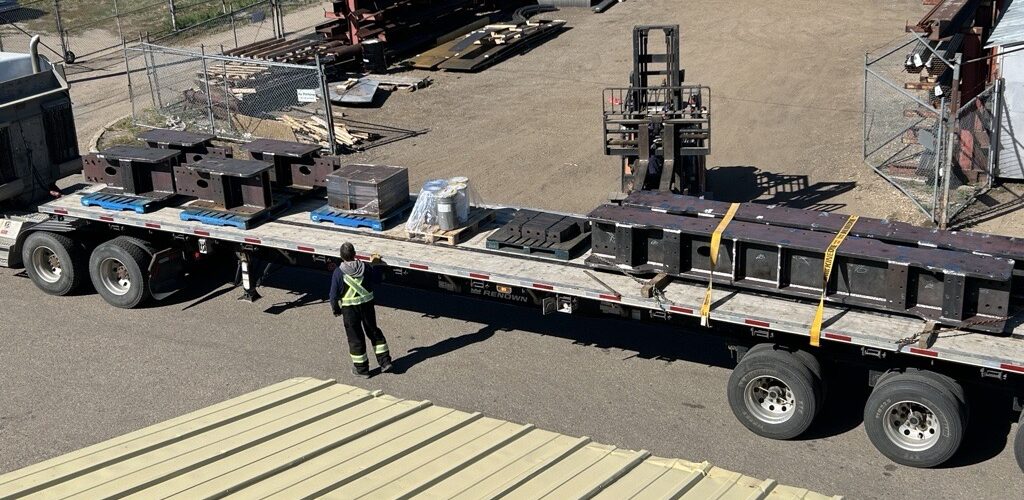
The completed assembly weighed nearly 92,000 lb. and consisted of 12 individual pieces. Each component had to be manageable enough for underground transport while becoming part of a structure capable of supporting the drilling operation once bolted together. The design was strain analyzed and engineered to withstand the significant forces generated during the raise.
The custom modular design allowed the unit to be assembled and dismantled after drilling so individual components could be extracted.
The assembly was test-fitted before delivery to confirm individual sections came together as designed. After the test fit of the extensions, the Thyssen Mining team reported “everything fits great.”
Working safely beside an eight-metre opening
Drilling two adjacent raises introduced another problem. Once the first eight-metre opening had been completed, crews working on the second raise would be operating directly beside it. Atlas was tasked with designing a safety platform to cover the first opening and provide a safe working surface for the drilling crew while work proceeded on the adjacent raise.
The platform was designed as a modular system so it could be installed over the completed raise and create the working area required for the next stage of drilling. Like the beam assembly, the design had to account for the constraints of an underground site, where components need to be transported into position and assembled within the available space.

Four raisebore assemblies and counting
While this project was significant for its scale, it wasn’t our only successful raisebore project. Atlas has now built four raisebore beam assemblies, contributing to several new mine shafts across North America.
Raisebore projects bring together the engineering, heavy fabrication, and problem-solving capabilities Atlas has developed since 1974. When the finished structure needs to withstand extraordinary forces, accommodate the constraints of an underground site, and still be transported, assembled, and removed, every part of the project needs to be planned before fabrication begins.
Have an underground mining or industrial project that requires custom engineering and heavy fabrication? Send Atlas your drawings and project specifications. We’ll be happy to talk about what the job needs.